
How scientists tackle their own life choices.
A professor at Columbia is agonizing over a job offer from a rival university. A colleague takes him aside: “Just maximize your expected utility — you always write about doing this.” The professor snaps back: “Come on, this is serious.”
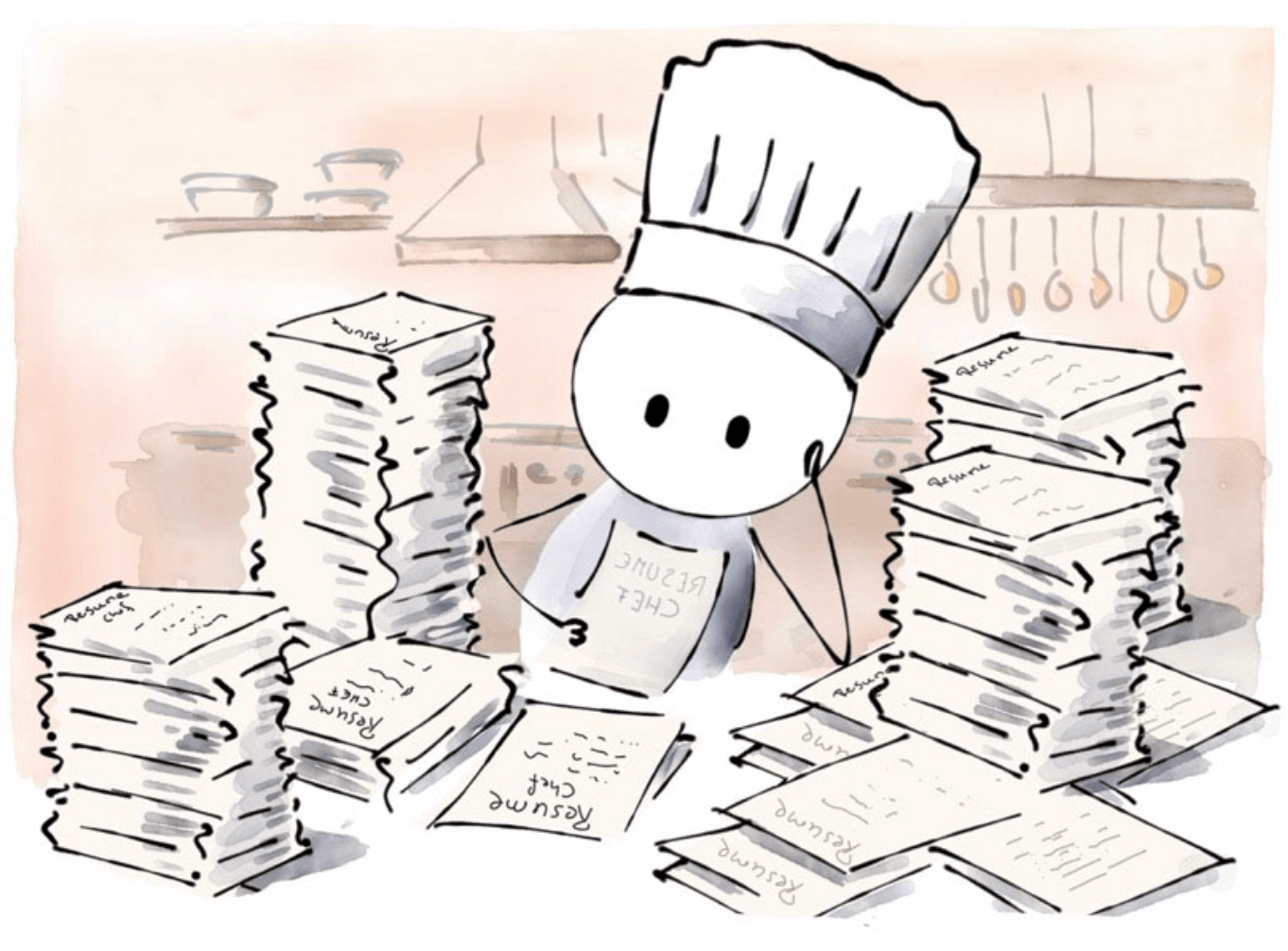
This is an anecdote the German decision scientist Gerd Gigerenzer has been telling for decades [e.g., 1, 2]. The cartoon above is a variation I drew for Art & Mind, the book Dan Hahn and I wrote together.
Gigerenzer’s point deserves to be stated fairly: he argues that simple rules of thumb often beat elaborate analysis, especially when the future is truly open. On his account, formal methods don’t merely fail to describe how we choose. Sometimes they do worse than our intuition.
On the other hand, decision science has a great deal to teach us about what makes a decision process good. And people who decide well tend to live better: those who score higher on decision-making competence report fewer bankruptcies, fewer divorces, fewer nights in a jail cell, among many other negative life events [4], [5], and the difference survives controls for age and income. People who reason in cost-benefit terms also get better grades and earn higher salaries [3]. The skill can be taught, too. In a randomized trial, tenth-graders given fifteen hours of decision training improved their decision-making competence — as well as their history grades [6]. So the knowledge exists, and it makes a difference.
Where decision science stops short of real life
First, while the insights of decision science hold up outside the lab, they have mostly stayed inside journals and graduate seminars, in language dense enough that the Gigerenzer story works as a joke. Nobody says “maximize your expected utility” to a friend who’s struggling.
Second, the field has spent far more energy on government and boardroom decisions than on the choices people lose sleep over. The biggest regrets in life cluster around education, career and romance [7], and that’s not where the research went.
Third, popular advice still sells intuition and analysis as rival camps. Follow your instincts, or be rational about it. Just pick one. But picking one is a problem, because the two need each other. A gut feeling can’t tell you why it’s uneasy, and a spreadsheet can’t tell you what to put in it.
Art & Mind is our attempt to close those gaps, without throwing out the rigor of the science, and without pretending your gut is always right either.
What the book does
It walks you through a full process for a hard decision:
- getting clear on what’s bothering you
- figuring out what you value
- generating options you haven’t thought of yet
- weighing tradeoffs without vacillating forever
- making peace with the uncertainty that’s left once you’ve done the work
It’s built from research and teaching material Dan and I have both spent our careers with, and from years of coaching people through exactly these moments.
Try it on a real decision
 There’s also a companion toolkit at decisionart.app, built alongside the book. It walks you through the same process on one of your own real decisions. The prompts work with a friend, or with an AI assistant. You can preview the opening chapters and try the toolkit there.
And if you get to the end of the preview and find it too riveting to stop, write to me. I’ll send you a promo code for full access to the e-book at a friend price.
The toolkit is free, whether or not you buy the book.
If you’d rather have it on paper

You can find the print edition on Amazon. It’s expensive because it’s printed in full color, which is also what makes it a great gift. Every illustration in it is mine, and they’re larger in print than in the e-book.
The Amazon sample shows the print layout in the opening chapters.
by Ursina Teuscher (PhD), at Teuscher Decision Coaching, Portland OR
References:
[1] Todd, P. M., & Gigerenzer, G. (2000). Précis of Simple heuristics that make us smart. Behavioral and Brain Sciences, 23(5), 727–741. https://pure.mpg.de/rest/items/item_2102521/component/file_2102520/content
[2] Gigerenzer, G. (2007). Gut feelings: The intelligence of the unconscious (pp. 3–4). Viking.
[3] Larrick, R. P., Nisbett, R. E., & Morgan, J. N. (1993). Who uses the cost-benefit rules of choice? Implications for the normative status of microeconomic theory. Organizational Behavior and Human Decision Processes, 56(3), 331–347. https://doi.org/10.1006/obhd.1993.1058
[4] Bruine de Bruin, W., Parker, A. M., & Fischhoff, B. (2007). Individual differences in adult decision-making competence. Journal of Personality and Social Psychology, 92(5), 938–956. https://doi.org/10.1037/0022-3514.92.5.938
[5] Parker, A. M., Bruine de Bruin, W., & Fischhoff, B. (2015). Negative decision outcomes are more common among people with lower decision-making competence: An item-level analysis of the Decision Outcome Inventory (DOI). Frontiers in Psychology, 6, 363. https://doi.org/10.3389/fpsyg.2015.00363
[6] Jacobson, D., Parker, A., Spetzler, C., Bruine de Bruin, W., Hollenbeck, K., Heckerman, D., & Fischhoff, B. (2012). Improved learning in U.S. history and decision competence with decision-focused curriculum. PLoS ONE, 7(9), e45775. https://doi.org/10.1371/journal.pone.0045775
[7] Roese, N. J., & Summerville, A. (2005). What we regret most… and why. Personality and Social Psychology Bulletin, 31(9), 1273–1285. https://doi.org/10.1177/0146167205274693
You must be logged in to post a comment.